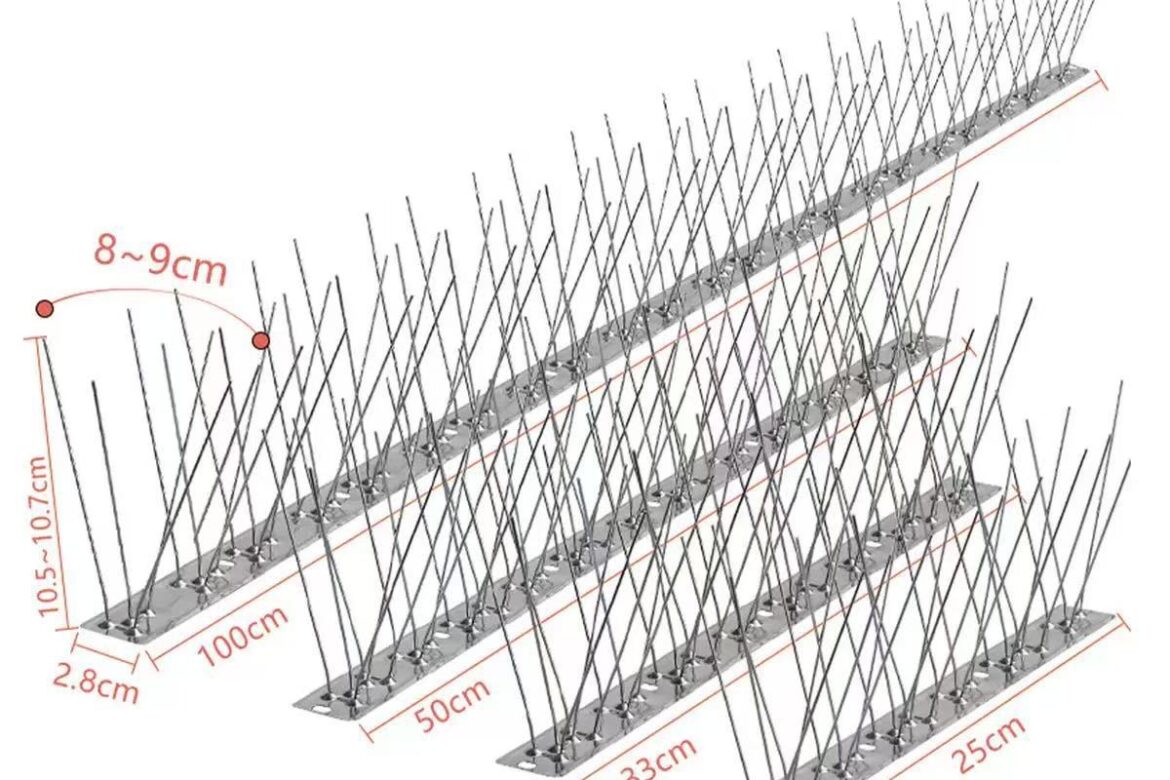
How to choose bird repellent? Engineering bird repellent must see selection guide!
Bird deterrence spikes (also known as bird spikes or bird deterrent spikes) selection depends solely on three factors: stainless steel wire material, base and spike density, and installation surface compatibility. Material determines lifespan, base and spike count determine the blocking effect, and installation method determines whether it will fall off during the first typhoon season. For bird deterrence projects, procurement also depends on whether the lead time aligns with your construction schedule.
Bird spikes are physical deterrent products designed to prevent birds such as pigeons, sparrows, and seagulls from finding flat surfaces to perch on.
The tips of bird spikes used in engineering are typically blunt or rounded, relying on density rather than sharpness to deter landing. Sharp spikes are prone to tangling during transportation and can easily cut workers during installation, which is particularly critical to avoid in roofing projects.
Birds can adapt and may also nest in gaps along the edges of bird-proof spikes, drainage channels, or component borders. Therefore, the length should be calculated based on the entire bird landing line during selection, rather than just covering the most frequently used spot. Reserve 10%–15% extra for corners, overlaps, and future retrofits.
The true cost of the base lies not in the procurement price but in the rework rate. Poor-quality bases after aging become brittle, with screw holes cracking and the entire piece falling off when exposed to wind. For outdoor projects with prolonged exposure, the base must be confirmed to be made of UV-resistant modified material.
Three mainstream structures: straight wire type, spring type, and multi-row base type
Straight wire type refers to multiple stainless steel wires directly fixed on the bottom strip, with the needle body perpendicular to the installation surface, covering a large area and suitable for flat surfaces such as roofs, curtain walls, and advertising board beams.
Spring type is formed by coiling a spiral steel wire, usually equipped with a U-shaped ring base, and clamped with bolts on angle steel, circular pipes or iron tower components. This structure is commonly used for bird strike prevention in power systems: it consists of 24 steel wires, wire grooves, and a U-shaped ring base. During installation, there is no need to drill holes in the components, making it particularly suitable for facilities such as transmission towers and substation structures that do not allow for arbitrary drilling.
Multi row base type is to embed several rows of short needles on a wide base, with the needle body unfolding in a fan shape, and the number of needles per unit length is denser. It is suitable for scenarios with narrow installation surfaces and larger bird body sizes, such as pipe supports, railings, and equipment box tops. When choosing this type of product, it is important to inquire about the spacing between the fixed holes on the base, as it determines whether you can reuse existing hole positions.
The difference between 304 and 316
The main material for stainless steel bird repellent is 304, which is suitable for indoor and outdoor use and is sufficient for conventional urban and inland industrial environments. 316 has added molybdenum element, which significantly enhances its resistance to chloride ion corrosion. It is recommended to use 316 directly in coastal areas within 10 kilometers, offshore platforms, coastal chemical parks, and sewage treatment plants. Otherwise, pitting corrosion will occur at the root of the needle body after two to three years, and the appearance will be unsightly. Secondly, it is troublesome for broken needles to fall onto photovoltaic modules or equipment.
201 material has a low price, but low nickel content and weak rust resistance. It is not completely unusable, short-term, dry inland, and temporary projects can be considered.
Frequently Asked Questions
Will bird stingers harm birds?
Qualified products use blunt pins, which birds will avoid during the judgment stage before landing, and the actual contact probability is very low. Its mechanism of action is to make the landing point unusable, rather than capture or damage.
How long can bird stingers last?
The lifespan is mainly determined by the material and installation quality. 304 can be used for a long time in conventional inland environments, while 316 is suitable for coastal high salt spray areas. The aging of the base, gel failure, and rusting of screws often cause problems earlier than the needle body, so acceptance and maintenance should be based on the overall situation, not just the steel wire.
What should I do if the bird still lands nearby even though I have installed anti bird spines?
Most likely, the coverage is incomplete. Birds will move to the eaves, drainage ditches, and equipment tops at the edges of bird stingers. By re checking along the bird line and filling in the gaps, the problem can usually be solved.
Can bird repellent be directly laid under the solar panel?
The triangular gap space between the component and the roof is narrow, and it is often difficult to install the strip directly, which is also inconvenient for maintenance. This type of position is more suitable for using specialized sealing components or steel wire brackets to seal the channel first, and then arranging bird proof spikes along the components.
How to determine the minimum order quantity and sampling cycle?
First, make a sample to confirm the specifications and workmanship, and then discuss bulk ordering.
You can directly send us the installation surface dimensions and bird line length, and the engineering and wholesale inquiries will be quoted according to the project.
Contact URL: https://www.anti-birdspikes.com/
Email: winnie@anti-birdspikes.com
info@anti-birdspikes.com
WhatsApp:+86 13205351335